Qahwa Saada is a Jordanian blog that discusses daily issues facing an average Middle Easterner on a broad variety of subjects, ranging from politics and economics to leisure and comedy.


”http://i766.photobucket.com/albums/xx310/ysmousa/free-internet-outline.png“
Coffee is more than merely a drink; in Jordan it is surrounded with custom and treated with reverence. It is not only a symbol of hospitality and trust, it is a traditional sign of respect and a way to bring people together. Black, cardomom flavored Arabic coffee, also known as "Qahwa Saada", is deeply ingrained in the Jordanian culture.

Usually having a bitter taste, beautiful aroma, and served in small portions into handle-less cups. It is closely associated with the Dallah - an iconic coffee pot of Arab culture. Serving coffee to guests is a large part of the culture's warm hospitality. (source)

Please feel free to contribute your feedback to ysmousa@yahoo.com

Friday, February 5, 2010

Tales of Emirati Camels

I've always admired camels for their everlasting cheerfulness, they always seem to be in a jumpy mood, with that cheeky smile drawn on their hairy faces, don't they?

Well the Emiratis have done it again with achieving the most eye-opening news yet!


Camel burger newest 'healthy' option
DUBAI (Reuters) - A traditional Emirati restaurant in Dubai has added a new entree to its menu billed as a fat-free choice for carnivorous but health-conscious diners: the Camel Burger. For 20 UAE dirhams ($5.45), the Local House restaurant offers a quarter pound camel burger, loaded with cheese and smothered in burger sauce, the Xpress weekly newspaper reported on Thursday. Ali Ahmad Esmail, Local House assistant manager, told the paper that the burger patties were fat- and cholesterol-free. But he declined to say how the outlet tenderised the tough camel meat. "It's a trade secret," he said. Camel meat is widely eaten in some Arab countries, but is not typically sold in supermarkets or served in restaurants. The paper reported that Local House said it was the first to introduce the burger in the United Arab Emirates. A fast food outlet in neighbouring Saudi Arabia put baby camel burgers on its menu last year.


UAE man pays $6.47m for 3 camels
DUBAI (AFP) - An Emirati splurged a whopping 24 million dirhams ($6.47 million) for three camels, including one which cost $2.72 million, at an auction in the desert near Abu Dhabi, an AFP photographer said. The auction was held Tuesday at the Dhafra Festival for Camels and was attended by the biggest camel owners in the Gulf, among them princes and tribal dignitaries. The other two camels cost United Arab Emirates national Hamdan Ben Ghanem around $2.4 million and $1.35 million respectively. Citizens of Gulf countries are passionate about camel racing, which is considered a national sport and tradition. At the festival, competitions are held for the best camel meat and camel milk dishes, and for the best poem written about camels.

The sad thing is that a pet camel has always been in the back of my mind, too bad the relatively large...or massive budget doesn't really fit my limits! Happy cameling folks!

Wednesday, February 3, 2010

Stereotypes About The Middle East; A Rising Concern

Was searching YouTube for something to feed my boredom last night, when I came upon Queen Rania's YouTube channel. For those who haven't heard, Queen Rania of Jordan has launched an initiative - or several - on YouTube and Twitter, to communicate to the Western world and talk about various stereotypes westerners have about the Middle East, Arabs, and Muslims. Some have even taken to calling her the 'cyber queen of the Middle East'. I thought it would be interesting to jot down my thoughts on the matter of stereotyping:

Firstly, a common, deeply flawed misconception is that all Middle Easterners are terrorists. Well, going back to 9\11 there sure were 17 terrorists who all came from the Middle East, were Arabs and Muslims. But how far can we take that fact to say that we all are terrorists? We can hardly say that such a vast population of over 360 million people are reflected by those 17 who performed this disgraceful act of suicide in the name of religion. Sure there are terrorists in the Middle East, but the same goes for any other country in the world. Middle Easterners are generally peaceful people, as a matter of fact, Jordan itself is known for its wonderfully warm hospitality to foreigners!

Middle Easterners live in desert tents and get around using camels. To be honest I have never heard such an absurd statement without letting out a sincere laugh. Cars are well used in society here, an amazing fact is that oil-rich countries in the Gulf, mainly Kuwait, have a higher number of cars than people! The world's tallest building is in the Middle East, namely 'Burj Khalifa' - more commonly known as The Dubai Tower - which exceeds a height of 828m, making it the highest man-made structure in the world!

Architects and engineers are fully present in the Middle East (some people may think we are all desert dwelling Bedouins), doing a wonderful job of ensuring citizens' comfortable and stylish accommodation.

Arabs are all Muslims; Muslims are all Arabs Neither of these statements are correct. Muslims make more than 1.5 billion of the worlds population. Arabs make only about 360 million people straddling North Africa and Western Asia. Now the second statement has been debunked, what about the first? Are Arabs all Muslims? Definitely not, a significant population of Arabs follow Christianity, with myself being one of them. Personally, having many Muslim friends whom I consider brothers and sisters, the respect I have towards Islam is concrete. Islam itself does not teach enmity and war, but peace and love, just like the other heavenly religions.


Women are given no rights in the Middle East.  This stereotype varies significantly from one country to the next. For instance, Saudi Arabia has yet to permit woman to drive, whereas the Jordanian female population enjoy plenty of rights and can be seen in various positions about the country, from university professors to taxi drivers to ministers.

Middle Easterners hate Jews. This also, is a common misconception. The hate Middle Easterners have is directed to the Zionist Israeli government, and not the religion Judaism, which has our utmost respect. The causes of this hate are vast, and for one to know how it all began, he would have to go back to the formation of the Zionist Israeli state, which in fact was formed by betrayal of Sherif Hussein of Mecca, who had been promised the land as part of his Arab state after WW2 by the British. At present day, however, this hate is due to the daily killing and slaughter of Palestinians, their expulsion from their own lands and the numerous other mistreatment they receive.

Arab countries are oil-rich. Partly true in the Arabian gulf region, but countries such as Jordan, Lebanon and Syria have negligible oil resources or none! Electricity generated in Jordan is 96% from oil and natural gas imported by neighboring countries. Jordan is now aiming at building renewable energy resources such as wind and solar, as well  as building nuclear power reactors for peaceful purposes due to the significant amount of uranium found in the Kingdom.. and yes, I can assure you I said peaceful. Car oil in Jordan as a matter of fact is ridiculously expensive!

I hope I have given you a reasonable perspective on these matters and please feel free to contribute your feedback if you may have a different point of view or would like to discuss these matters in a deeper manner.

Please spare some time to view Queen Rania's pages on YouTube and Twiter at http://youtube.com/queenrania and http://twitter.com/queenrania

Sunday, January 31, 2010

Israeli - Jordanian Peace on the Brink

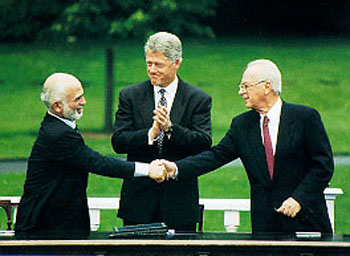
It has been more than fifteen years since Prime Minister of Jordan Abdelsalam al-Majali declared an "end to the age of wars" and Shimon Peres declared that "the moment of peace has arrived", since King Hussein and Yitzhak Rabin held their legendary meeting with President Clinton at the White House to sign that treaty that was to bring peace to the region... to the Palestinians, and to end that everlasting conflict that has been raging ever since I can remember.

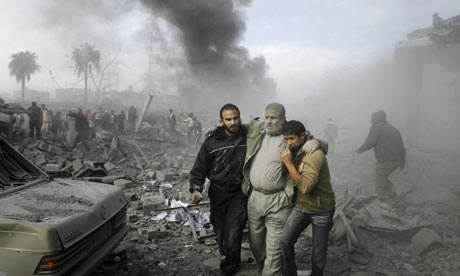
Looking around today, you can hardly say that the Middle East is at rest. With Iraq shattered to pieces, Iran's nuclear revolution, Yemen's civil wars, AlQaeda still at large and with no doubt, the walls going up around the Palestinians in the West Bank and Gaza. We hear of suicide bombings, blood and death daily in our community, which has become accustomed to this outrageous news. Not to mention the endless protests that are held against various parties in our countries.
 
When it comes to the Israeli - Jordanian peace, to what extent has it really been effective? Well we can say that mutual recognition has been achieved, borders and security cooperation too, but even those matters are subject to debate.

With the Israeli Knesset announcing last year that "Jordan is Palestine", I would say what was the point of the treaty in the first place?!

Daily reports about excavations and building of trenches under and Al Aqsa mosque in Jerusalem have been a primary cause in the building of hate in the Arab mind towards Israel.
Article 9 of the treaty states: "Freedom of access to places of religious and historical significance. Israel would respect the special role of the Hashemite Kingdom of Jordan in Muslim Holy shrines in Jerusalem."
From my point of view I can hardly see any Jordanian influence in Jerusalem these days!

What about refugees? Article 8 clearly states "The problem of displaced persons would also be discussed together with Egypt and the Palestinians, and the issue of refugees would be discussed in a multilateral manner in conjunction with and at the same time as the permanent status negotiations pertaining to the territories."  Palestinian refugees are increasing by day, with no dispute or talks whatsoever - with the able fleing to neighbouring countries including Jordan, Lebanon, Syria and Egypt. To add to that Israel accuses Jordan of consisting of a large population of Palestinians and even proposes a Palestinian state East of the river in Jordan. What hypocrisy, as if Israel is not to blame!

If we were to observe matters from another perspective, how often do Netanyahu and King Abdullah organise talks and debates? Haaretz reports: "Since becoming prime minister last year Netanyahu has met King Abdullah only once, in May, a few days before the premier's visit to Washington. The king urged Netanyahu to declare his acceptance of a two-state solution to the Palestinian-Israeli conflict and delivered stern criticism about construction in the settlements and Israeli activities in East Jerusalem."

Israeli and Jordanian sources point to Abdullah's lack of trust in Netanyahu, which the king expressed in a May 2009 interview to The Times of London, just a few days before meeting with the prime minister. "I had three months with the overlap (after the death of King Hussein in 1999, during Netanyahu's first term). These were probably the least pleasant of my 10 years."

To add to that, a statement was issued by Prime Minister of Jordan Samir Rifai when asked if "Jordan will grant permission for Israeli aircraft to pass over Jordan to Iran". His reply was "Israeli aircraft will be shot down if this were to occur." Another sharp statement was made by the King himself about a year ago, giving Israel a 12-18 month ultimatum saying "Peace now, or its war next year." King Abdullah has tagged Israel with the term "fortress Israel" many times in his various interviews worldwide, accusing Israel of remaining as a fortress with no diplomatic relationships with its neighbours rather than "integrating into the neighbourhood".

On other note, yesterday claimed the 48th birthday of his Majesty the King where he issued several strict statements that “We will not be a new occupation in Palestine” , he stated that peace, supported by most Palestinians and Israelis, is the only solution to the conflict. This peace, he added, is based on the two-state solution, and added that he will not accept any talks or even hints of a Jordanian role as a power controlling Palestine.

The King further stated that Jordan will always assist the Palestinians in achieving their own state on their land.  During his speech at the Economic Forum in Davos, King Abdullah said that his army will not be the new army the replaces the Israeli forces in Palestine, and that the Palestinians are demanding to achieve their legitimate right of an independent state.

Tuesday, January 19, 2010

Lack of Vitamin B12 in the Jordanian Society


According to Cheryl Haines of HighBeam research: "Ask most Jordanians about vitamin B12 and chances are they, or someone they know, will be taking weekly injections to combat a supposed deficiency in this important bodily vitamin."

This does not come as a surprise to me, as my father and my grandmother both take routine vitamin B12 injections.

Cheryl adds: " While no official records currently exist at the Ministry of Health, one doctor contacted by The Jordan Times estimates that 80 per cent of her patients are B12 deficient.

Several health practitioners noted similar figures, claiming that a significant portion of the population requires weekly injections to alleviate the symptoms commonly associated with a deficiency -- fatigue, difficulty concentrating and muscle weakness."

This is not a good sign for Jordanians, for the symptoms stated above can clearly lead to a decline in a person's physical and mental performance.

Vitamin B-12 is the largest and most complex vitamin currently known to man. A slight deficiency of vitamin B-12 can lead to anemia, fatigue, mania, and depression, while a long term deficiency can potentially cause permanent damage to the brain and central nervous system.

Sunday, January 17, 2010

Made in Jordan

The idea of getting a job in the Ferrari Industries may seem impossible, but with will and determination, anything could become a reality.  This is the fruit of a story I read in Torque, the primary automobile magazine in Jordan, about Ala Qubain, a young Jordanian who accomplished that very same dream.
Ala Qubain, like many young Jordanians, took his bachelors degree without knowing what lay ahead of him, and then headed to the United States to continue his studies in Engineering.

It all started at the Indianapolis Formula 1 race track, for when he witnessed those cars flashing by he realized that the automobile world was his dream. From then on, he was persistent in becoming part of that world. In the next year's race, he decided to give out a copy of his resume to the team leaders hoping to get to work with one of them. Days passed without any news and he knew that he was hardly a match with the other applicant specialists.

His decision was to enrol in Imperial College London, which has a worldwide reputation in Automobile Engineering, and continue his doctoral studies in Aerodynamics. It was then he gained his experience and began talking to his supervising professor about using air jets as an aerodynamic assistant in automobiles. Therefore, it wasn't of surprise when his supervising professor called him one day for a talk - that wasn't about his levels of achievement - a talk that was bound to change his life.

It was about a work opportunity. Ferrari was looking for young skilled engineers that were to be given a scholarship and to work in their industries. Ala accepted immediately, for he had finally achieved his goal!

So he started working, along with Ferrari engineers, on his project which consisted of air jets that were to variate movement of air particles to increase or decrease their pressure on car bodies.

The results were significant, and validated the assumption that air jets could be used to fluctuate pressure, so Ferrari offered Ala a part in the Millano team. There, he began integrating the air jets onto the limited Ferrari 599XX, the second car of its type after the FXX. The jets proved as a great success and sparked a great deal of interest that Ferrari decided they should be mass produced. It was a great despair that the chosen company for mass producing the unit did not comply.

While Ala was in Amman, he received numerous messages requesting him to return to Italy. Obliging to some of his friends' requests he headed to the King Abdullah II Design and Development Bureau (KADDB) - a governmental body used chiefly for local military development and research - and after briefing them on the unit, he built it himself! 

In Italy, his unit gained a wide reputation and it was then he saw the ultimate opportunity and proposed the idea that he would build the air jets for Ferrari, and thus he started a company for this purpose. In my eyes, this story is a message that must be remembered, a message that states clearly that the possibilities are endless. That one must challenge their own in achieving all they can, set their personal goals to the highest limits imaginable, and attempt to achieve nothing but the most inspired dreams.

Saturday, January 16, 2010

Medical Tourism in Jordan

An article that sparked my attention today was an article I read in AlGhad news, under the headline "Government undergoes study to lower medical costs for intensive care".

According to AlGhad, the government plans to decrease costs of medical care for patients staying for more than a week in Jordanian hospitals. Dr. Fawzi Al Hammoury, head of the Jordan's Private Hospitals Association, estimates this discount as percentage between 20% and 40% depending on the patients medical situation.

This discount comes as a key in enhancing Jordan's medical tourism, which is not only limited to foreign and Arab patients, but Jordanians as well. Dr. Hammoury noted that the World Health Organisation (WHO) and the World Bank now place Jordan within the top 5 countries in the world in the field of medical tourism and the leader in the Middle East.

He also notes that the medical care costs are significantly lower than both Great Britain and the United States with a percentage of 20 - 40%, as well as the neighbouring countries by 5 - 10%.

Middle East News wrote in their article "Jordan pushes medical tourism industry" on Sunday, December 20 - 2009 that: "Jordan has been at the forefront of the medical industry in the Middle East since the 1970s" and "Adding to the kingdom's reputation is the fact that most of its doctors are English-speaking and many have been trained or are affiliated with top US hospitals such as the Mayo Clinic and Johns Hopkins... Other features that make that Jordan a popular healthcare destination are sight-seeing attractions such as Petra and the Dead Sea and the fact that its capital, Amman, is considered one of the cleanest cities in the world."

"Come here, do your surgery. Afterward, have a vacation, visit Petra, swim in the Dead Sea," Dr. Hammouri  said, listing the country's most popular tourism destinations. The hospitals are offering package deals, including air travel. To add to that, Jordan also hosts the only specialized cancer centre in the Middle East, the King Hussein Cancer Centre and Foundation.

I was extremely impressed by our medical facilities and standards upon reading this, and being a current medical student I was inspired to learn more about the international reputation the country has earned and further about the various successes Jordanian doctors have achieved in medicine.