Qahwa Saada is a Jordanian blog that discusses daily issues facing an average Middle Easterner on a broad variety of subjects, ranging from politics and economics to leisure and comedy.


”http://i766.photobucket.com/albums/xx310/ysmousa/free-internet-outline.png“
Coffee is more than merely a drink; in Jordan it is surrounded with custom and treated with reverence. It is not only a symbol of hospitality and trust, it is a traditional sign of respect and a way to bring people together. Black, cardomom flavored Arabic coffee, also known as "Qahwa Saada", is deeply ingrained in the Jordanian culture.

Usually having a bitter taste, beautiful aroma, and served in small portions into handle-less cups. It is closely associated with the Dallah - an iconic coffee pot of Arab culture. Serving coffee to guests is a large part of the culture's warm hospitality. (source)

Please feel free to contribute your feedback to ysmousa@yahoo.com

Tuesday, August 31, 2010

Faculty of Medicine logo

Seeing as there was a competition last week for designing the logo of the Faculty of Medicine at Jordan University of Science and Technology, I decided to give it a shot and participate. The design is pretty simple; more or less the original logo of the university with the 'staff and snake' medical symbol, and a bit of slanting to give it that 'in motion' effect. So what do you think? I'd appreciate some feedback.

Monday, August 30, 2010

It's My Life

More than a year has swept by since I last dusted the soles of my shoes at the towering gates of school, since I took those wary first steps into the unknown world of higher education, making the daring decision of choosing to pursue the degree of Medicine over that of Mechanical Engineering, struggling to find a solution to the various challenges that came my way, with success being my foe at times and my accomplice at others. An annum of contrast and experience I must say, packed with emotions and thoughts that I would have found hardly possible at an earlier while. This, my dear readers, is a recollection of notable memories that I underwent, ranging from those first tastes of university life, to the mingling and integration into the Jordanian public, to learning how to drive in the bustling streets of Amman. As simply as the kind Jon Bon Jovi puts it, "It's my life".

I shall start this series of recollections by introducing a friend of mine who, I'm saddened to say, I no longer have contact with. It was a bright day, the sun was shining so boastfully on a blazing hot summers morning, I was approaching the old ticket booth at the Northern Bus Complex, more commonly known as "Mojamma3 Al Shamal", where I was to begin my journey for the first time to Jordan University of Science and Technology (JUST); little did I know that this would become my second home for the next six years to come. Ascending the squeaky steps of the 42-seat Hyundai bus and looking around, I found a seat next to a drowsy young lad who went by the name 'Omais'. It was honestly hard getting his name at first; interpreting his name as 'Anis' and 'Omar' didn't do me very well, so I ended up calling him 'M3allem' or 'Seedi' most of the the time. Omais came from a rough background, he was from one of the less well-off towns of Jordan called 'Mahis', and a second year Chemistry student at JUST. What made him stick out so vividly in my memory is the fact that he was so willing to help me on my first visit under no circumstances whatsoever; the determination in him was something I very much admired, and nothing I said would stop him from touring me around the university, let alone insist on buying me a Coke and Shawarma on his budget.

I admit the tour wasn't at all very fascinating, but it was more than I deserved. After permitting me to sit-in a refreshing air-conditioned lecture with him, I discovered Omais wasn't the brightest of students; on the contrary, he was rather the opposite, and was barely coping with his studies. To my utter shock, he had already received an ultimatum from the university, threatening to disqualify him from the upcoming academic year had he not passed in his subjects. Sitting at the cafeteria next to the university pond, the scenery was amazing; a cool breeze made it's way across the landscape through the withering leaves above us, ducks were quacking merrily unaware of their surroundings, and it seemed the weather had changed for the better. We were talking about each others' history and getting acquainted; he had an upcoming exam in an hour and was facing difficulties with problem solving so I decided to give my assistance where possible. 'Integration and differentiation', I thought. Had it not been for my ingenious A-level school teacher I would have been utterly lost in the subject. The last I heard of Omais he was planning on re-starting his studies at the Hashemite University in Zarqa, his attempts on convincing me that JUST was the most strict and difficult college in the country left me rather confused. At the end of the day, we bid each other farewell, and each of us went our own way; that was the last I heard of him. Omais was my first acquaintance at JUST, I honestly hope he is doing well.

From that I take you to the end of the first university semester. It was a fluid one overall, the subjects were ones I had covered previously in my A-levels, with the exception of Arabic, thus I didn't face much difficulty and spent most of the time messing around in Irbid, '3aroos Al Shamal'. I also chose to accommodate myself with a close and sincere friend I had made, named Ehab from the city of Nablus; we had met on the bi-articulated bus, popularly called 'Al Doodeh' translated 'The Worm', that leads from the Engineering Faculties Complex to the Medical Faculties Complex; I had unwaveringly sided myself against a group of elder students attempting to criticize the first-years, how exactly I honestly don't recall.

It was my pleasure one evening that I got invited over to a couple of friends' house in Irbid whom I had met from my Arabic class; arriving late on a daily manner and issuing my apologies so bluntly interrupting the lecture must have had something to do with it. We were coming close to the final exams, and these international students from Kuwait and Yemen approached me for some assistance with biology, as studying in English was somewhat of an obstacle for them. So I agreed to help-out and tutor them as much as possible. Escorting them through the suburbs of Irbid, we went through the city where students form a majority, the city which has gained global reputation for having the largest number of internet cafes per capita in the world as accredited by Guinness. The sun was gradually setting behind the oblique skyline of weathered stone houses, draped with dull laundry, with the scenting rich Arabian coffee emulsifying around us from the nearing coffee house.

Climbing the uneven concrete steps lined with crack-swarmed walls, a gentle wind made its way through the open window. The door opened with an enchanting creak and I was ushered with warm smiles into the house. The strongly fragranced incense had me coughing almost immediately, the smoky environment inside the house was one that had me with surprise, but I got accustomed, and soon I curiously began contemplating the Arabian floor-based furniture where the table was merely several inches above ground, something I found interesting. I was kindly gestured for, yes, Arabian coffee the Yemeni way, and although I claimed I didn't want to cause any trouble, my hosts insisted. The shining silver Dallah sparkled with life as it was placed on an extravagant fire upon the aluminum-covered oven. We comfortably sat down on a soft array of reddish-black Arabian-designed pillows on the floor, around a unique date-filled pot, a small plate of water used for washing 'daty' fingers, and the freshly-brewed coffee was poured by the hosts filling us with an enthralling aroma. At the creeping sound of silence, I remembered why I was there, and beckoning them to open their books, I attempted to begin tutoring.

TO BE CONTINUED...

Friday, July 2, 2010

The Jordanian Nuclear Bomb

Over the past few weeks, a topic that has been progressively drawing my attention is that of the United States demanding that Jordan relinquish its rights to produce its own nuclear fuel and sign an agreement similar to that of the United Arab Emirates, which will commit Amman to purchasing its reactor fuel from the international market to guard against its potential internal diversion for military purposes.

What is more is that King Abdullah has accused Israel of interfering with Jordan's nuclear plans, as well as instructing his foreign minister to formally reprimand Israel's ambassador to Jordan over the charges that Israel has been seeking to block the sale of the South Korean or French reactors to Jordan.  As stated by The Wall Street Journal:
"There are countries, Israel in particular, that are more worried about us being economically independent than the issue of nuclear energy, and have been voicing their concerns," King Abdullah said. "There are many such reactors in the world and a lot more coming, so [the Israelis must] go mind their own business."
What is ironic is that Jordan has the right to produce it’s own fuel under the Nuclear Nonproliferation Treaty, neither the US nor Israel can deny those rights, with specific emphasis on Israel who refuses to sign the treaty and expose it’s nuclear capabilities. I honestly believe there should be a note in global treaties stating that: "These guidelines are applicable EXCEPT in Middle Eastern nations where the circumstances may differ accordingly", considering that each Arab/Middle Eastern country get’s their own permissions regarding what they can do/can’t do with nuclear power.

Jordan has all the means to go ahead with the nuclear program regardless of what the US and Israel think. South Korea and France will be more than willing to consent to Jordan’s needs without the US, though with the green light from the US everything will become much simpler, as some technology in French and South Korean reactors is American and requires US consent for export. As a matter of fact, the first 5MW reactor has already been agreed on and inked with South Korea, and is set to be complete in 2015 in Jordan University of Science and Technology, the college which I attend.

Furthermore, it is well known that Jordan is desperate for energy independence, 95% if not more of power produced in the Kingdom is imported. A nuclear Jordan will very much increase economic stability and will pave the path for achieving it’s water needs too, as the power is planned to be used for water desalination in Aqaba.

That is not all however, I was glad to see former Israeli Justice Minister, Yossi Beilin, write an article for the New York Times in which he defended the Jordanian nuclear project and criticized the Israeli government's objection to this, as well as reproaching the US government for indulging Israel's request to put pressure on Jordan's nuclear project. He is quoted saying:
In the situation that we justifiably or unjustifiably find ourselves now — boycotted and isolated — we do not need to lose the only Arab state with which we have peace-like relations.

Why should his [King Abdullah] country be denied the right to use its own uranium to produce energy? Why suspect his country of doing exactly what it has said it won’t do? Why deny Jordan nuclear technology out of fear of some “worst-case scenario” whereby his regime collapses and is replaced by one that attempts to develop a bomb? This could occur in many other places.

There is a certain risk in allowing Jordan to enrich uranium so close to Israel’s border, but the risk in denying the king’s request is far greater.
Finally, I am displeased to say that the coverage of this subject in Jordanian media has been minimal and largely neglected; I would have hoped for better reportage considering it's importance.

UPDATE July 3rd '10: 
Minister of State for Media Affairs and Communications and Government Spokesperson Nabil Sharif told The Jordan Times that “talks are ongoing to sign a nuclear cooperation agreement between the two countries and reports of problems hindering this endeavour are baseless”.

UPDATE July 5th '10:
"There are details that are being discussed but I don't know why, when discussions take a bit longer, people always conclude that there is a problem. There isn't a problem," Jordan's foreign minister Nasser Judeh said at London's International Institute for Strategic Studies think tank.

"We are friends of the United States, ... the United States recognises Jordan's pressing need for a peaceful nuclear programme for our energy purposes. We are a country that imports all of its energy resources. I think the United States is very supportive of that," he said.

UPDATE July 12th '10:
The United States is threatening to stop providing financial assistance to Jordan if the country continues developing its nuclear program without coordination with Israel.**

**It turns out the claims, which appeared on the Israeli news site Ynet, are false.  Quoted from Palestine Note:
Washington - Senior Jordanian and US officials have denied an Israeli news report that the US threatened to cut financial aid if it refuses to coordinate with Israel in developing its nuclear program. The officials told Palestine Note that the report, which appeared on the Israeli news site Ynet, was not true.
UPDATE July 14th '10:
France supports Jordan’s right to enrich uranium as outlined in the nuclear Non-Proliferation Treaty, the top French diplomat in Amman, ambassador Corinne Breuz said during a press meeting to mark Bastille Day.

"There is no reason for Jordan not to build its own nuclear reactor," she said in response to a question, adding that Paris respects Jordan’s commitment to various international conventions and International Atomic Energy Agency regulations.

Tuesday, June 15, 2010

Random Thoughts

So here I am, after a rather delicious meal of home made mansaf, staring at my online Organic Chemistry slides, and waiting for the information to be fed into my brain. I've got my final exams now, and I finish in a few days on the 17th. Honestly I can't wait one bit, though the hard truth is that once I'm on holiday I'll be back to that awkward feeling being useless and bored, even though I know I'll be spending my time eating shawarma and swimming at Al Hussein Youth City. Just the thought of that makes me drool, yeehaa.

It is weird how the only time I have that will to educate myself about worldly matters, politics and read the news is when I'm in study stress. It's like I'll be sitting on the sofa, sipping on a cup of mint tea, watching the news with great fascination, with a truck load of books waiting to be read in the next room. What's worse is that I'll usually have an exam right the next day, as is the current case with Organic Chem. Now it'll be alright if that wasted time was about an hour or so, but once I've begun messing around, the realization that it is ENOUGH does not hit me hard until 3 or 4 hours have swept by.

What I don't get at all is the method of teaching at our Jordanian universities, or I would rather not generalize, so I'll limit it to Jordan University of Science and Technology. I mean the syllabus is awesome, you would say "hey, this stuff is really advanced, I'm going to just love these topics!", and in the end the semester turns out to be messed up and on a totally different part of the spectrum than you would expect.

Why, you might ask? Well I would like to put the blame primarily on our beloved professors, (excuse the thought that I might not be paying attention during class). What happens is that some professors, take it that their students are nothing but absolute geniuses, so any question a student might ask will be shameful and offensive in their eyes. What is more is that their standards of communication in English language aren't that brilliant either, but they consider themselves to be more or less native speakers of the language - ambassadors of Shakespeare himself to the Middle East. Well I admit I was picturing none other than my Organic Chemistry professor, so again, I must emphasize that generalization is wrong, and you've got others who are just lovable, and yes, I am being serious now.

The bigger problem is that at times, even the syllabus turns out to be wrong, as I reluctantly learned during my Physiology exam a few weeks back, for which I spent a day or so studying for things that weren't included in our exam, ironic eh? I would also like to blame the Ministry of Higher Education for the inconsistency of dates between Jordanian institutes of higher learning. As an example of this, the University of Jordan, where many of my friends study, has been on midterm vacation for more than a week. On the other hand, we are still entrenched in exams and finish only a few days before our fellow UJ students begin their summer semesters! The least the kind ministry could do is uniform the dates.

Anyhow, there's another half hour gone for practically nothing. I'm off to continue staring at those beautiful chemistry slides - wish me luck.

Monday, June 7, 2010

My Views on the Gaza Flotilla Raid

I would like to say that these thoughts are strictly my own, and do not necessarily reflect the opinion of any other Arab, Jordanian, or supporter of the Palestinian case. I am a strong believer in humanity, and I strictly believe that those who don't have the power and will to think and fight for themselves are a useless part of our global community.

The reason I am saying this is that I was challenged today with the question of whether or not soldiers in the Israeli army have a choice or not. Are they merely a force of power used in missions to kill and overpower people or do they have the heart to make decisions on their own? Personally, I would like to think that they had that opportunity to decide for themselves, but from what I've read, witnessed and heard, I find that hardly plausible.

It takes a man to say yes to committing to an army, to fulfill the every demand and requirement burdened upon him, and to have the courage to believe that his superiors will always make the better decisions for the benefit of his people and country. What happens in Israel, however, is not the same case. Conscription is not a voluntary choice, it is a strict requirement for males and females at the age of 18. Those that choose elsewise choose persecution by the government or even death. Thus, they are left with no choice, and I would like to say, brainwashed into believing that Israel is right, Arabs and Muslims, and anyone who opposes the Zionist government are a threat to the stability and existence of Israel.

It is sarcastic I say "existence" of Israel when the state was actually formed as a result of betrayal of the Arabs by the British, when the land was supposed to be part of a greater Arab state as promised, and is based actually on the fact that it was the home of Judaism around 3000 years ago. If my memory serves me correctly, I recall it was professor Norman Finkelstein who said: "If I came to your house and told you that my family, according to my book, lived here 3000 years ago, would you pack up and leave?" The mere creation of Israel has created havoc in the Middle East, refugees are swarming everywhere. It is amazing that that the Middle East used to be home for all three heavenly religions, Judaism, Christianity, and Islam, where people were living side by side in a brotherly way. Don't get me wrong however, the creation of Israel is past me, my country, Jordan, has made peace, and I stay by it. Peace in the region is indeed what I would like to see.

The Gaza Flotilla raid was, in my opinion, a selfish act of cruelty, terror, and stupidity committed by the State of Israel. It shows to what extent the Zionist government is ready to go to keep the people of Gaza in a state of isolation, malnutrition, and underdevelopment. As far as I've heard up to 20 innocent civilian activists were killed as a result of this massacre. The flotilla clearly didn't contain any weapons, as stated by the IDF and later dismissed as pictures that were taken back in 2006, the link of which can be found on my twitter account. Let alone the attack took place in international waters, making it a war crime by definition. I was honestly surprised to see Barack Obama, the man who so many people had faith in, dismiss the event and call for further investigations to be done by Israel. I must say, great choice choosing the state who committed the act to "further investigate".

I have also been recently challenged by the question of "What do I benefit of when I post and tweet about events occurring in Gaza, it's not like I'm stopping any offenses or influencing world leaders." My reply to that will be awareness, it is of critical importance that awareness of the incidents that are happening does spread, and the unfiltered, unedited reports reach the public blankly enough for them to realize that these offenses must not go by unnoticed, and something must indeed be done to help these people.

Sunday, May 23, 2010

The Wikipedia Revolution: How a Bunch of Nobodies Created The World's Greatest Encyclopedia

I must admit it has been quite a while since my last blog post, can't say there's a specific reason, but laziness and medical studies come as the main factors, my apologies.

So the focus of this post will be about how I've recently been into editing Wikipedia, or The Free Encyclopedia; I'm sure you've used it at some point, it is, after all, usually one of the primary results in a Google Search. Ever imagined where these articles came from, who wrote them, who contributed, and who edited? Well I doubt you have, it honestly isn't something I would do, but being a recent editor has got me thinking, how much credit do these contributors really get for their work, is there anyone who says well done, good job, or even thank you?

The surprising thing is that the majority of people in our society don't know editing is actually possible, which makes it quite obvious why Middle Eastern articles are somewhat low-grade compared to those of the Western world, and by low-grade I really mean that there is much room for improvement. Gratitude? Can't say they get any, that is unless it is from their fellow Wikipedians, usually represented as a barn star posted on the user's talk page; a page on which discussions about user edits are made.
My contributions until now have mainly targeted articles about the Middle East, two articles I am especially interested in are "Jordan University of Science and Technology", the college which I currently attend, and "Suleiman Mousa", my late grandfather, who was the first and only Arab author to write about T.E. Lawrence, or "Lawrence of Arabia", and show the Arab perspective.

What do you need to become an editor? Nothing much really; an e-mail account, a sufficient command in the English Language, good grammar skills, and suitable references for any ad
ditional information you might want to add to an article, or else it will be deleted by an administrator.

I would definitely recommend  becoming a contributor to Wikipedia, with no doubt there will be articles of interest to everyone, and increasing one's spectrum of knowledge is also a pleasant side factor. Beware though, it is a very time-consuming business, so choose your time carefully.

Tuesday, April 6, 2010

Stand-Up Comedy in Jordan

Had I been asked about stand-up comedy a few years ago, I would have replied that I knew nothing about it. Today, however, my answer is a whole lot different - surprisingly enough, this wild act has miraculously been taken to a new level of popularity amongst the people of Jordan and the Middle East.

After receiving a message last night informing me that a two hour stand-up comedy show was to be held at university the next day, performed by students and with free admittance, I was delighted. It was shear bad luck that I was persuaded by some friends to hang out for a while, and then continue to the show. Assuming that our fellow Arabs were most probably bad performers and you would be quite lucky if you even smiled, we headed to the show after half an hour from it's starting, what awaited us left us in complete shock; not only were all the seats taken and the sounds of laughter earsplitting, but students were crammed all over, the doors were jammed and what's more, many of them had cameras! It honestly was a memorable experience...


Not a while back some global comedians were in town too... Russel Peters, the Canadian stand up comic and actor, as well as the Axis of Evil comedy tour including Aron Kader, Maz Jobrani, Ahmad Ahmad and Dean Obeidallah, all witnessed massive success amongst the Jordanian people. As a matter of fact Russel Peters even got punk'd by King Abdullah II of Jordan! Not to mention the hilarious Lebanese comedian Nemr Abu Nassar or.. "the Tiger", who performed in the Cultural Palace in Amman a couple of weeks ago to about 1,800 people, more or less the largest stand-up comedy event to take place in the Middle East yet!

You've all heard of the common stereotype that Jordanians always have that disturbing frown drawn on their faces. To some extent, that stereotype may ring true, but my fingers are crossed - the young generation of stand up comedy Jordanians is up for the challenge to change that soon. As a side note, I've always heard laughter is good for the soul, and I can't but agree all the way; how bad is it really to laugh at one another? I sure do hope these events keep coming!

Tuesday, March 30, 2010

Book Review: Uneasy Lies The Head - King Hussein of Jordan

A few weeks ago I came upon a dusty, time-worn book buried in the stacks my grandfather used to read. At first, I neglected it as I did with most before, but then the title sparked my attention and I was drawn by the fact that the author was no less than the previous ruler of our country, the founder of modern Jordan, King Hussein.

"Uneasy Lies The Head", an autobiography written by HM King Hussein, tells the story of a young boy of 17, forced to endure the threats and perils of life around him, but predominantly, single-handedly  given the abrupt responsibility of ruling a nation swarmed with disaster, shortly after the assassination of his grandfather the first ruler of Trans-Jordan, King Abdullah I, and merely escaping death himself.

This book recollects the enthralling activities of our beloved King and shows the times of happiness and joy in contrast to those of betrayal, various attempts to overthrow the monarchy, and bitter hate. An adventure beginning  from the few months of Harrow and Sandhurst as an Arab in a foreign territory, continue to the memories of racing a Rover, learning to fly a plane, being crowned as King, disguising himself as a taxi driver, being deceived by close comrades, attempts on his life, and ending with his marriage to Muna Al Hussein. Not to mention the numerous other incidents that took my breath away..

The experience of this autobiography took me on a journey that was far more than fascinating, it made it clear how personal strength and perseverance have a vital role in life, how a collection of events may be so magically assembled as a result of timeless efforts, hard work and wisdom to present a masterpiece.

I honestly found this book, this eye-opening recollection of memories and experiences, a thoroughly entertaining one, rich in value and moral, and would definitely recommend it to each and every individual, regardless of their background and culture. Pleasant reading everyone.

Friday, March 12, 2010

Blog About Jordan Day: Why I Love Being an Ammani

"Blog About Jordan Day" is finally here, and I can't but admit that I was almost planning on "forgetting it", but after all, it is an event that occurs once yearly, and being a new blogger, I thought I'd give it a shot. It then hit me, what better could I write about than the rather exquisite lifestyle of an Ammani - the lifestyle that most locals take for granted.

So WHY exactly do I love being part of Amman? What makes my lifestyle so fascinating that I decided to blog about it? Well like most people, my lifestyle does have it's ups and downs, but I can't help but realize that people around me tend to overlook the good happening around them and focus on the bad, which is why I took the time to point out the factors in our lives that we fail to notice.

I love the SMELL of Amman. Yes, that scent of Jordanian air upon waking up each morning does play a role in my life, a significant one too! I vividly remember arriving at Queen Alia International Airport a few years ago, that feeling I got when I stepped out of the plane and took my first whiff of fresh Jordanian breeze was really exhilarating, to the extent that I remember asking if anyone could smell that..

..which brings me to the Ammani WEATHER. Oh how I love the weather here; how often do you find a country that gets all four seasons so properly felt and enjoyed; spending time at the pool in summer, watching those leaves turn that beautiful reddish brown in autumn, a winter under the rain and snow (although we didn't get much this year), and a spring BBQ'ing in the lovely outdoors.

Another thing about being an Ammani is that you always seem to find MUTUAL FRIENDS with whoever you meet, as if we were just one small happy family. Honestly, it does seem kind of ironic; but it's true, it's like everyone knows everyone else!

I love how TAXI DRIVERS in Amman always have a subject to talk about when you hop in; they always seem to be blabbering don't they? Whether it's about how they can't cope with the expenses of sending their kids to school or if they just find your shirt too colorful, they must have something to say!

I am also quite fond of the BACKGROUND SOUNDS you usually hear in an Ammani neighborhood. Birds tweeting, gas trucks with their Beethoven music (doubt you'll find that anywhere but here), the cotton candy man going around the streets playing his harmonica, the corn man shouting "doraay" for all those kids waiting for him, the sounds are rather unique really!

Lastly, I completely admire the fact that wherever you are in Amman, you always have that SAFE feeling; you never feel intimidated! It is in all honesty something we regularly overlook and take for granted, security in Amman and Jordan is another subject on it's own.

Well enjoy your Friday everyone. I wish you a lovely "Blog About Jorday Day" and "World Day Against Cyber Censorship", make it meaningful!

Wednesday, March 10, 2010

Friday 12th of March; World Day Against Cyber Censorship

I would like to admit, that a couple of months ago, I would have not imagined Friday the 12th of March to be a significant day at all. Today, however, the tables have turned and this Friday will be of major importance for bloggers all over Jordan and even the world. This Friday will mark both "Blog for Jordan Day" and "World Day Against Cyber Censorship". My main focus in this post will be about the latter.

The idea of discussing "World Day Against Cyber Censorship" would not have occurred to me had it not been for Naseem Tarawnah, author of "The Black Iris of Jordan", who posted about the subject and made it clear what the day meant in his post "Dear Jordanian Bloggers & Tweeps: Let’s Mobilize For March 12th".

I can't say I am an expert on the subject, but the moment I decided to look into it I found the shocking statistics that there are actually countries that are totally against Internet  and the web, nicknamed "Internet Enemies". I was honestly relieved to find out that Jordan was not in the list and was highly ranked in the regions Internet Freedom Index. The bigger shock was to find the majority of our neighboring Arab countries listed as "Internet Enemies", with the Index describing their Internet connections as being more or less of an Intranet, in other words a local network of sites with some exceptions. Of these countries were neighboring Egypt, Syria and Saudi Arabia.

Arab countries that were listed to be "Under Surveillance" by the government included Bahrain, the United Arab Emirates, and Yemen. It was also a surprise to find Australia listed to be under surveillance; being one of the largest and most influential countries in the world, I would have thought it hardly plausible.

Now you might be asking, "So what if these countries are "Internet Enemies", or "Under Surveillance"?". Well if you wouldn't prefer to be jailed for speaking your mind on the web, as was the case with an Egyptian blogger not a while back, you would rather not be under those lists. In my opinion, I really think these "Internet Freedom" indexes should be linked with a country's "Freedom of Speech" index; that is if they haven't been linked already.

Jordan, nonetheless, wasn't a perfect country in the Index. For example newspaper columnist Mwaffaq Mahadin and Sufian Tell, a specialist in environmental issues, were held for 15 days for criticizing the assistance which the Jordanian intelligence services provide the United States in its fight against Al-Qaeda.

"Reporters Without Borders" is concerned about a ruling by Jordan’s highest appeal court, published on 13 January, that news websites and electronic media are subject to the country’s press and publications law. Media and communications minister Nabil Al-Sharif told the Jordan Times that the court’s decision was reached independently and should therefore be applied.

All in all, I urge all Jordanian bloggers to make this a subject of one of their posts. If not, a logo and slogan can be obtained and placed on your web space to show your support for the campaign.

Saturday, March 6, 2010

Language and Culture

"Arabs that don't know Arabic are honestly a disgrace..", my dear friend, who currently studies in Canada, went on to say as we were chatting a couple of days ago. His point of view may have seemed extreme for a second or two at that time, but the more I thought about it, the more it seemed to make sense. How can somebody claim to be part of a culture he hardly knows anything about?

Can anyone imagine a French man who can't speak French, or doesn't know what baguette or crepe is? I find that hardly plausible. Or a Spaniard who hasn't heard about bullfighting, a corrida de toros?  How sarcastic would it be if you met a Russian who knows nothing about Vodka, or a Mexican who hasn't ever tasted tortillas?

Culture is what identifies us in today's community, it is what makes us who we are and gives us that uniqueness when we meet a person from a totally different background.

 So what exactly makes a person forget his culture, his blood, one might ask? Well it seems the answer is quite clear; Immigration, Emigration, and the influence of other cultures play a decisive role in a person's life.  To add to that, parents who forget the principles of teaching their children where they originate from are also a significant factor. We also can't deny what influence international media has on us. With the United States dominating media all over the globe, it isn't a surprise that the world is getting more and more Westernized with time.

So let's get back to the Arab perspective. "An Arab who doesn't know Arabic is a disgrace..", what do you think? My friend went on to say how he had once considered the Arabic language as a difficult one in school, where he could hardly keep up with the grammar that was taught in class, how he felt that it was a waste of time, a useless subject for those who were going on into a scientific field in college.

He continued to say that as time progressed and he became a foreigner in Canada, his identity became increasingly important to him, and he found that the Arabic language was an essential part of his Arab culture.

Personally, being an Arab, a Jordanian to be specific, I totally believe in culture and the moral values that have made me who I am today, and I honestly think that an individual must proudly hold his culture high, and ensure that it is not lost with the generations to come.

Tuesday, March 2, 2010

Men-Sushi

"Men-Sushi, what's that?" At first thoughts, you'll probably be saying its just an extra large sushi plate specifically made for men with their "special hunger needs", but NO, on the contrary it has NOTHING to do with sizes whatsoever!

Well it seems you've been missing out on the latest food trends in town! Surprisingly, this new "professionally designed" meal hasn't the slightest taste of Sushi, but resembles it in many ways. In fact, it may come as great news for those Mensaf-loving locals that a 3rd eating method for Mensaf has now been introduced.

We all know the traditional method, that involves the strategic 45 degree hand-angle dipping, squishing and artistically forming that juicy Mensaf-ball, and the neat spoon method for those who prefer a little less messiness. I am glad to present to you the new method that ingeniously combines the two stated above to give you "Men-Sushi", the Mensaf-lovers' ideal way for "Mensaf-on-the-run".

Imagine Mensaf-balls readily shaped to perfection in a Sushi-like structure, with a luscious, tender piece of meat on top, wrapped with a meek layer of bread, and a dip specially ordered from Karak, for those who crave an excess of Jameed on their Mensaf ball, to give that final, mouth-watering magical touch! Aren't we in heaven?

Sunday, February 28, 2010

Water Scarcity in Jordan

Warmly seated at home, here I am, enjoying the splitter and splatter of raindrops at my window, thankful for the generous quantities of rainwater Jordan has received this season, and hoping for a green spring and summer to come.

Today, Jordan ranks as one of the most water-scarce countries in the world, facing the major issue of being able to supply it's rising population with it's water needs.
Driving around in Amman on a rainy day, it comes as quite a surprise to me that a large number of streets are completely submerged in water, that drainage and sewage systems always seem to be blocked up on a rainy day, and that all that flood water is not benefited of. To add to the sarcasm, a significant amount of the kingdom's water is imported from neighboring countries!

Ever since I moved to Amman, a noticeable feature in our residence has been the integrated rainwater well we have underground. This 3m3 (three meters cubed) well plays a vital role in our summer lives. The amount of water it is able to hold is something I honestly find fascinating, such that is provides an immediate alternate to government water and can be used for various purposes including gardening and everything but potable water; that is unless an adequate filter is implemented.

Now hypothetically, what if, to some extent, the government would put into action a program that would make it compulsory for each new building to have a built-in rainwater well underground? Just imagine the tremendous amounts of water that could be stored from this straightforward plan, not to mention the ridiculously large sums of government money that could be saved and made use of elsewhere.

Well I hope water plans for the Kingdom work out well, and wish you all a happy rainy day.

Monday, February 15, 2010

Texting & The Distractions of Driving

Commuting has by no doubt become a part of our daily lives. According to US government statistics, Americans now spend over 100 hours a year commuting. Although one may say driving is a necessity, the rules that allow it to be safe must be strictly laid down. This brings me to our main topic, the distractions of driving and how they may affect the performance of the driver.

According to Jordanian Public Safety, officials state that on average 2 people are killed and 50 more are injured in 145 road accidents each day. These statistics are quite vast if you ask me, but what exactly are the causes of these accidents? It may be surprising to find out that they are merely due to lack of concentration caused by various distractions affecting the driver. Text messaging and cell phone use, munching on a snack, listening to excessively loud music, or perhaps smoking a cigarette, not to mention the harmful effects that has, are only a few examples of these distractions.

A survey released by mobile application vendor Vlingo says 26 percent of mobile phone users questioned admit to DWT, or driving while texting. Driving while texting is now fully banned in seven states in the US as well as Washington, D.C., and partially banned in a select few other states. Eighty-three percent of the people surveyed said they feel texting while driving should be illegal. But 40 percent of those questioned would OK DWT with the proper safety precautions, such as voice-activated commands. Further, 70 percent would use voice technology to speak and listen to incoming messages as opposed to typing and reading.

"In just one year, the public conversation about the issue of DWT has escalated, particularly in the wake of some high-profile accidents," said Dave Grannan, CEO of Vlingo. "Texting is such an integral component of our daily lives, and the cautionary tales about DWT danger have not stemmed the tide. We predicted last year that this problem would get worse, and it has since more people are texting."

However, a study conducted from Carnegie Mellon University found that just listening to cell phone messages can impair a driver's ability to concentrate on the road. The Oprah Winfrey show also hosted a program that validated this assumption under the title "The Risks of Texting While Driving - Multitaskers Beware!".

 "The human brain isn't equipped to concentrate on two things simultaneously," says neuroscientist René Marois, PhD, associate professor of psychology at Vanderbilt University in Nashville.

To add to that Alghad News published an article today which stated that the average usage of a cell phone while driving is equivalent to a certain dosage of alcohol thus significantly lowering reaction time of the driver. Alghad also noted that the number of fines given for phone usage while driving in Jordan in 2009 exceeded 138350.

Saturday, February 13, 2010

Volunteer Work with KHCC & KHCF

A little while back I applied as a volunteer with King Hussein Cancer Center & Foundation (hereafter KHCC & KHCF). The King Hussein Cancer Center is the only specialized cancer center in the Middle East that treats both adult and pediatric patients. I thought it would be a great way to spend my spare time instead of lazing around at home… and it turns out I wasn’t the least bit mistaken.

After receiving a phone call a few days ago requesting me to be part of an awareness campaign about cancer, I gladly headed to City Mall to find out what exactly I had to do. Upon reaching the booth where my 4 hour shift was to begin, I was greeted with warm arms and my fellow volunteers explained it all. It was quite a surprise to find that the 11th of February was the worlds cancer day; which I had no idea existed. We were to distribute brochures and leaflets among the people which were about the various types of cancers, how they could be prevented and methods of treatment, with specific emphasis on smoking and its harmful effects. As well as that we were also holding booths for donations to KHCC & KHCF, and for a health insurance program against cancer.


The experience was refreshing; getting to know my fellows in the booth and mingling with the Jordanian society. With no doubt there were some people who did not give us their attention, but on the other hand there were many who did, who shared their opinion about the matter and told us about their own experiences with cancer. It was very interesting to learn so much and at the same time contribute to the people’s knowledge.

To add to that, we even had our own benefits, which included a free meal complement of the center; which was of course “healthy” in their opinion, unlike the junk food we would normally get.

Those 4 hours could have honestly been just 30 minutes with the fascinating time I had - getting to know those wonderful people, learning plenty of new info, and with no doubt contributing to the awareness of society.

Sunday, February 7, 2010

King Hussein - The Jordanian Icon

How often do we stop to say, to actually think, what this day actually means in history? How often are we thankful for the community, for the country in which we are embraced? Jordan, as we now know it, has evolved through history, under the few Hashemites who sacrificed their all, to build and maintain a country which prospers in life. We owe it all to our Hussein of Jordan, who was the longest reigning ruler in the world; 5 decades as a matter of fact, to ensure that Jordan became what it has turned out to be on this day.

Today marks the 11th anniversary of the passing of His Majesty King Hussein of Jordan. One might be fascinated by the amount of stress and pressure a person might handle, but at the same time astonished at the kind, warm, welcoming smile that person has drawn upon his bright face. King Hussein was that loving, kindhearted person who underwent those many times of war, revolution, crime and distress. It was this same person, who became an icon for peace in the world and a model for many countries in the Middle East and worldwide.

I can vividly recall the words written in his autobiography, about how his life all began by the disgraceful assassination of his grandfather the founder of Jordan, King Abdullah I, at the doors of Al Aqsa Mosque in Jerusalem. How Hussein also merely escaped death himself, by a medal he had worn on his uniform across his chest, as requested by his grandfather, which had miraculously blocked the bullet from piercing the very walls of his own heart.

The story of Hussein's life is one which must not be forgotten and bears a huge legacy to every citizen of this country. It shows us how a mere boy of 16 was given the responsibility of ruling a nation and commanding an army. How this boy grew up to become a noble king of great reputation among his people.

As Wikipedia states: "Hussein guided his country in the context of the Cold War, and through four decades of Arab-Israeli conflict, balancing the pressures of Arab nationalism and the allure of Western-style development against the stark reality of Jordan's geographic location. His commitment to democracy, civil liberties and human rights helped to make Jordan a model state for the Middle East, and the kingdom is internationally recognized for having the most exemplary human rights record in that region. He worked tirelessly and continuously throughout his life to advance the cause of peace between Jordan and Israel (which he successfully achieved in 1994), as well as between Palestinians and Israelis."

To this day, a Jordanian still remembers the incident of Hussein's sickness while he was in Britain, where upon being requested to remain a while until the symptoms had declined, he insisted that he wanted to be with his people and "to feel their warmth surrounding him". He then flew his own plane to the grounds of the Kingdom, where he was greeted with the loving smiles and waving arms of the Jordanian people.

With no doubt, I must also praise our King Abdullah II, who has continued the work of his beloved father to ensure the prosperity and development of the Jordanian society. Who has maintained the stability of a Kingdom in the midst of a region swarmed with war and disastrous events, and prevented any harm from touching this nation.

I sincerely hope time will not forget the great achievements King Hussein has achieved and all the effort he has put in making Jordan the wonderful nation it is today.

Friday, February 5, 2010

Tales of Emirati Camels

I've always admired camels for their everlasting cheerfulness, they always seem to be in a jumpy mood, with that cheeky smile drawn on their hairy faces, don't they?

Well the Emiratis have done it again with achieving the most eye-opening news yet!


Camel burger newest 'healthy' option
DUBAI (Reuters) - A traditional Emirati restaurant in Dubai has added a new entree to its menu billed as a fat-free choice for carnivorous but health-conscious diners: the Camel Burger. For 20 UAE dirhams ($5.45), the Local House restaurant offers a quarter pound camel burger, loaded with cheese and smothered in burger sauce, the Xpress weekly newspaper reported on Thursday. Ali Ahmad Esmail, Local House assistant manager, told the paper that the burger patties were fat- and cholesterol-free. But he declined to say how the outlet tenderised the tough camel meat. "It's a trade secret," he said. Camel meat is widely eaten in some Arab countries, but is not typically sold in supermarkets or served in restaurants. The paper reported that Local House said it was the first to introduce the burger in the United Arab Emirates. A fast food outlet in neighbouring Saudi Arabia put baby camel burgers on its menu last year.


UAE man pays $6.47m for 3 camels
DUBAI (AFP) - An Emirati splurged a whopping 24 million dirhams ($6.47 million) for three camels, including one which cost $2.72 million, at an auction in the desert near Abu Dhabi, an AFP photographer said. The auction was held Tuesday at the Dhafra Festival for Camels and was attended by the biggest camel owners in the Gulf, among them princes and tribal dignitaries. The other two camels cost United Arab Emirates national Hamdan Ben Ghanem around $2.4 million and $1.35 million respectively. Citizens of Gulf countries are passionate about camel racing, which is considered a national sport and tradition. At the festival, competitions are held for the best camel meat and camel milk dishes, and for the best poem written about camels.

The sad thing is that a pet camel has always been in the back of my mind, too bad the relatively large...or massive budget doesn't really fit my limits! Happy cameling folks!

Wednesday, February 3, 2010

Stereotypes About The Middle East; A Rising Concern

Was searching YouTube for something to feed my boredom last night, when I came upon Queen Rania's YouTube channel. For those who haven't heard, Queen Rania of Jordan has launched an initiative - or several - on YouTube and Twitter, to communicate to the Western world and talk about various stereotypes westerners have about the Middle East, Arabs, and Muslims. Some have even taken to calling her the 'cyber queen of the Middle East'. I thought it would be interesting to jot down my thoughts on the matter of stereotyping:

Firstly, a common, deeply flawed misconception is that all Middle Easterners are terrorists. Well, going back to 9\11 there sure were 17 terrorists who all came from the Middle East, were Arabs and Muslims. But how far can we take that fact to say that we all are terrorists? We can hardly say that such a vast population of over 360 million people are reflected by those 17 who performed this disgraceful act of suicide in the name of religion. Sure there are terrorists in the Middle East, but the same goes for any other country in the world. Middle Easterners are generally peaceful people, as a matter of fact, Jordan itself is known for its wonderfully warm hospitality to foreigners!

Middle Easterners live in desert tents and get around using camels. To be honest I have never heard such an absurd statement without letting out a sincere laugh. Cars are well used in society here, an amazing fact is that oil-rich countries in the Gulf, mainly Kuwait, have a higher number of cars than people! The world's tallest building is in the Middle East, namely 'Burj Khalifa' - more commonly known as The Dubai Tower - which exceeds a height of 828m, making it the highest man-made structure in the world!

Architects and engineers are fully present in the Middle East (some people may think we are all desert dwelling Bedouins), doing a wonderful job of ensuring citizens' comfortable and stylish accommodation.

Arabs are all Muslims; Muslims are all Arabs Neither of these statements are correct. Muslims make more than 1.5 billion of the worlds population. Arabs make only about 360 million people straddling North Africa and Western Asia. Now the second statement has been debunked, what about the first? Are Arabs all Muslims? Definitely not, a significant population of Arabs follow Christianity, with myself being one of them. Personally, having many Muslim friends whom I consider brothers and sisters, the respect I have towards Islam is concrete. Islam itself does not teach enmity and war, but peace and love, just like the other heavenly religions.


Women are given no rights in the Middle East.  This stereotype varies significantly from one country to the next. For instance, Saudi Arabia has yet to permit woman to drive, whereas the Jordanian female population enjoy plenty of rights and can be seen in various positions about the country, from university professors to taxi drivers to ministers.

Middle Easterners hate Jews. This also, is a common misconception. The hate Middle Easterners have is directed to the Zionist Israeli government, and not the religion Judaism, which has our utmost respect. The causes of this hate are vast, and for one to know how it all began, he would have to go back to the formation of the Zionist Israeli state, which in fact was formed by betrayal of Sherif Hussein of Mecca, who had been promised the land as part of his Arab state after WW2 by the British. At present day, however, this hate is due to the daily killing and slaughter of Palestinians, their expulsion from their own lands and the numerous other mistreatment they receive.
Arab countries are oil-rich. Partly true in the Arabian gulf region, but countries such as Jordan, Lebanon and Syria have negligible oil resources or none! Electricity generated in Jordan is 96% from oil and natural gas imported by neighboring countries. Jordan is now aiming at building renewable energy resources such as wind and solar, as well  as building nuclear power reactors for peaceful purposes due to the significant amount of uranium found in the Kingdom.. and yes, I can assure you I said peaceful. Car oil in Jordan as a matter of fact is ridiculously expensive!

I hope I have given you a reasonable perspective on these matters and please feel free to contribute your feedback if you may have a different point of view or would like to discuss these matters in a deeper manner.

Please spare some time to view Queen Rania's pages on YouTube and Twiter at http://youtube.com/queenrania and http://twitter.com/queenrania

Sunday, January 31, 2010

Israeli - Jordanian Peace on the Brink

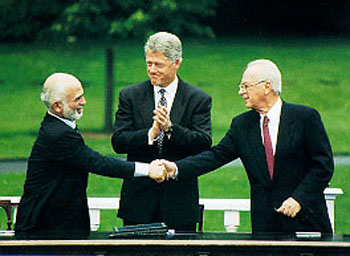
It has been more than fifteen years since Prime Minister of Jordan Abdelsalam al-Majali declared an "end to the age of wars" and Shimon Peres declared that "the moment of peace has arrived", since King Hussein and Yitzhak Rabin held their legendary meeting with President Clinton at the White House to sign that treaty that was to bring peace to the region... to the Palestinians, and to end that everlasting conflict that has been raging ever since I can remember.
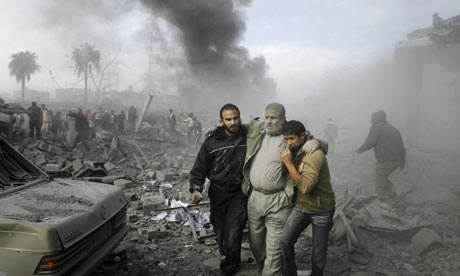
Looking around today, you can hardly say that the Middle East is at rest. With Iraq shattered to pieces, Iran's nuclear revolution, Yemen's civil wars, AlQaeda still at large and with no doubt, the walls going up around the Palestinians in the West Bank and Gaza. We hear of suicide bombings, blood and death daily in our community, which has become accustomed to this outrageous news. Not to mention the endless protests that are held against various parties in our countries.
 
When it comes to the Israeli - Jordanian peace, to what extent has it really been effective? Well we can say that mutual recognition has been achieved, borders and security cooperation too, but even those matters are subject to debate.

With the Israeli Knesset announcing last year that "Jordan is Palestine", I would say what was the point of the treaty in the first place?!

Daily reports about excavations and building of trenches under and Al Aqsa mosque in Jerusalem have been a primary cause in the building of hate in the Arab mind towards Israel.
Article 9 of the treaty states: "Freedom of access to places of religious and historical significance. Israel would respect the special role of the Hashemite Kingdom of Jordan in Muslim Holy shrines in Jerusalem."
From my point of view I can hardly see any Jordanian influence in Jerusalem these days!

What about refugees? Article 8 clearly states "The problem of displaced persons would also be discussed together with Egypt and the Palestinians, and the issue of refugees would be discussed in a multilateral manner in conjunction with and at the same time as the permanent status negotiations pertaining to the territories."  Palestinian refugees are increasing by day, with no dispute or talks whatsoever - with the able fleing to neighbouring countries including Jordan, Lebanon, Syria and Egypt. To add to that Israel accuses Jordan of consisting of a large population of Palestinians and even proposes a Palestinian state East of the river in Jordan. What hypocrisy, as if Israel is not to blame!

If we were to observe matters from another perspective, how often do Netanyahu and King Abdullah organise talks and debates? Haaretz reports: "Since becoming prime minister last year Netanyahu has met King Abdullah only once, in May, a few days before the premier's visit to Washington. The king urged Netanyahu to declare his acceptance of a two-state solution to the Palestinian-Israeli conflict and delivered stern criticism about construction in the settlements and Israeli activities in East Jerusalem."

Israeli and Jordanian sources point to Abdullah's lack of trust in Netanyahu, which the king expressed in a May 2009 interview to The Times of London, just a few days before meeting with the prime minister. "I had three months with the overlap (after the death of King Hussein in 1999, during Netanyahu's first term). These were probably the least pleasant of my 10 years."

To add to that, a statement was issued by Prime Minister of Jordan Samir Rifai when asked if "Jordan will grant permission for Israeli aircraft to pass over Jordan to Iran". His reply was "Israeli aircraft will be shot down if this were to occur." Another sharp statement was made by the King himself about a year ago, giving Israel a 12-18 month ultimatum saying "Peace now, or its war next year." King Abdullah has tagged Israel with the term "fortress Israel" many times in his various interviews worldwide, accusing Israel of remaining as a fortress with no diplomatic relationships with its neighbours rather than "integrating into the neighbourhood".

On other note, yesterday claimed the 48th birthday of his Majesty the King where he issued several strict statements that “We will not be a new occupation in Palestine” , he stated that peace, supported by most Palestinians and Israelis, is the only solution to the conflict. This peace, he added, is based on the two-state solution, and added that he will not accept any talks or even hints of a Jordanian role as a power controlling Palestine.

The King further stated that Jordan will always assist the Palestinians in achieving their own state on their land.  During his speech at the Economic Forum in Davos, King Abdullah said that his army will not be the new army the replaces the Israeli forces in Palestine, and that the Palestinians are demanding to achieve their legitimate right of an independent state.

Tuesday, January 19, 2010

Lack of Vitamin B12 in the Jordanian Society


According to Cheryl Haines of HighBeam research: "Ask most Jordanians about vitamin B12 and chances are they, or someone they know, will be taking weekly injections to combat a supposed deficiency in this important bodily vitamin."

This does not come as a surprise to me, as my father and my grandmother both take routine vitamin B12 injections.

Cheryl adds: " While no official records currently exist at the Ministry of Health, one doctor contacted by The Jordan Times estimates that 80 per cent of her patients are B12 deficient.

Several health practitioners noted similar figures, claiming that a significant portion of the population requires weekly injections to alleviate the symptoms commonly associated with a deficiency -- fatigue, difficulty concentrating and muscle weakness."

This is not a good sign for Jordanians, for the symptoms stated above can clearly lead to a decline in a person's physical and mental performance.

Vitamin B-12 is the largest and most complex vitamin currently known to man. A slight deficiency of vitamin B-12 can lead to anemia, fatigue, mania, and depression, while a long term deficiency can potentially cause permanent damage to the brain and central nervous system.

Sunday, January 17, 2010

Made in Jordan

The idea of getting a job in the Ferrari Industries may seem impossible, but with will and determination, anything could become a reality.  This is the fruit of a story I read in Torque, the primary automobile magazine in Jordan, about Ala Qubain, a young Jordanian who accomplished that very same dream.
Ala Qubain, like many young Jordanians, took his bachelors degree without knowing what lay ahead of him, and then headed to the United States to continue his studies in Engineering.

It all started at the Indianapolis Formula 1 race track, for when he witnessed those cars flashing by he realized that the automobile world was his dream. From then on, he was persistent in becoming part of that world. In the next year's race, he decided to give out a copy of his resume to the team leaders hoping to get to work with one of them. Days passed without any news and he knew that he was hardly a match with the other applicant specialists.

His decision was to enrol in Imperial College London, which has a worldwide reputation in Automobile Engineering, and continue his doctoral studies in Aerodynamics. It was then he gained his experience and began talking to his supervising professor about using air jets as an aerodynamic assistant in automobiles. Therefore, it wasn't of surprise when his supervising professor called him one day for a talk - that wasn't about his levels of achievement - a talk that was bound to change his life.

It was about a work opportunity. Ferrari was looking for young skilled engineers that were to be given a scholarship and to work in their industries. Ala accepted immediately, for he had finally achieved his goal!

So he started working, along with Ferrari engineers, on his project which consisted of air jets that were to variate movement of air particles to increase or decrease their pressure on car bodies.

The results were significant, and validated the assumption that air jets could be used to fluctuate pressure, so Ferrari offered Ala a part in the Millano team. There, he began integrating the air jets onto the limited Ferrari 599XX, the second car of its type after the FXX. The jets proved as a great success and sparked a great deal of interest that Ferrari decided they should be mass produced. It was a great despair that the chosen company for mass producing the unit did not comply.

While Ala was in Amman, he received numerous messages requesting him to return to Italy. Obliging to some of his friends' requests he headed to the King Abdullah II Design and Development Bureau (KADDB) - a governmental body used chiefly for local military development and research - and after briefing them on the unit, he built it himself! 

In Italy, his unit gained a wide reputation and it was then he saw the ultimate opportunity and proposed the idea that he would build the air jets for Ferrari, and thus he started a company for this purpose. In my eyes, this story is a message that must be remembered, a message that states clearly that the possibilities are endless. That one must challenge their own in achieving all they can, set their personal goals to the highest limits imaginable, and attempt to achieve nothing but the most inspired dreams.

Saturday, January 16, 2010

Medical Tourism in Jordan

An article that sparked my attention today was an article I read in AlGhad news, under the headline "Government undergoes study to lower medical costs for intensive care".

According to AlGhad, the government plans to decrease costs of medical care for patients staying for more than a week in Jordanian hospitals. Dr. Fawzi Al Hammoury, head of the Jordan's Private Hospitals Association, estimates this discount as percentage between 20% and 40% depending on the patients medical situation.

This discount comes as a key in enhancing Jordan's medical tourism, which is not only limited to foreign and Arab patients, but Jordanians as well. Dr. Hammoury noted that the World Health Organisation (WHO) and the World Bank now place Jordan within the top 5 countries in the world in the field of medical tourism and the leader in the Middle East.

He also notes that the medical care costs are significantly lower than both Great Britain and the United States with a percentage of 20 - 40%, as well as the neighbouring countries by 5 - 10%.

Middle East News wrote in their article "Jordan pushes medical tourism industry" on Sunday, December 20 - 2009 that: "Jordan has been at the forefront of the medical industry in the Middle East since the 1970s" and "Adding to the kingdom's reputation is the fact that most of its doctors are English-speaking and many have been trained or are affiliated with top US hospitals such as the Mayo Clinic and Johns Hopkins... Other features that make that Jordan a popular healthcare destination are sight-seeing attractions such as Petra and the Dead Sea and the fact that its capital, Amman, is considered one of the cleanest cities in the world."

"Come here, do your surgery. Afterward, have a vacation, visit Petra, swim in the Dead Sea," Dr. Hammouri  said, listing the country's most popular tourism destinations. The hospitals are offering package deals, including air travel. To add to that, Jordan also hosts the only specialized cancer centre in the Middle East, the King Hussein Cancer Centre and Foundation.

I was extremely impressed by our medical facilities and standards upon reading this, and being a current medical student I was inspired to learn more about the international reputation the country has earned and further about the various successes Jordanian doctors have achieved in medicine.